Coronavirus & The Plague of Self-Interest

Up until just yesterday, Canadians were repeatedly told that closing our borders to travellers from infected regions will do nothing, because said travellers can always bypass flight restrictions by first flying to a country with no restrictions, or by simply lying about their travel history. At the same time, we were told that asking suspected or confirmed coronavirus patients to “self-quarantine” themselves, with virtually no oversight provided aside from (we should hope) their own conscious, is a perfectly reasonable and smart thing to do.

Because people who want to travel, for whatever reason, will do just that, and there’s apparently nothing we can do to stop them. But people who want to break their self-quarantine, for whatever reason, will… not do just that? Our officials may invoke The Science alleged to be informing their actions however many times they like, but one does not need any sort of educational or professional qualifications to understand that this reasoning simply doesn’t hold up.

Meanwhile, in the real world, if we can expect that people might lie about their travel history, we should certainly expect that people might lie about remaining in self-quarantine. Moreover, it now appears that a large percentage of our recent coronavirus cases have been “imported” from the only nation with which we share a land border: the United States. Closing this border would appear to be the most obvious and sensible thing to do — but leave it to the Canadian government to be egregiously involved in the day-to-day lives of its citizens during the best of times, and almost entirely absent and ineffectual at precisely the moment when we really do need them to do something, anything at all.

For the lion’s share of the outbreak, the World Health Organization had embarked upon a most virtuous crusade to combat the real threat facing our so-called “global village”: hurt feelings. Aside from their persistent and rather patronizing calls for people the world over to engage in proper hand-washing protocol, the only other activity of note from the WHO over much of the last two months had much less to do with the virus itself than with how people feel about the virus.

In other words: perhaps the real virus is the stigma generated along the way.

Now, it is quite easy, and admittedly quite tempting, to chalk all of this up to mere incompetency. However, I do not personally believe this to be the case — at the very least, it’s not the whole story. Rather, I do believe there to be at least some sort of method behind this madness.

Imagine: you’re one of the big-shots at the WHO. You have an extremely virulent and potentially deadly sickness making its way around the globe, and you are, of course, expected to do something about it. Unfortunately, as a branch of the UN System, you are forced to juggle your commitment to the globalist project with that of your core mandate — public health. This means that several potential options for combating the spread of the virus are off the table before negotiations even begin.

In brief:

  • You can’t (openly) encourage countries to implement travel restrictions, because this will have too much of a negative impact on the global economy (not to mention the implications of giving the impression that wide-open borders not always being a good thing);
  • You can’t encourage countries to implement more heavy-handed screening processes for potential coronavirus patients, because this will freak people out;
  • You can’t (openly) call for the same kind of large-scale, city-wide quarantines as those seen in China, because the residents of most other countries are unlikely to tolerate such a thing (and it will freak people out, and be bad for the economy);
  • You can’t be entirely honest about the overall difficulty of the situation we’re facing, because this would further undermine the already-limited confidence that much of the public has in your organization. At any rate, you absolutely cannot admit that you’re stuck between a rock and a hard place, trying to strike a balance between the interests of the global economy and that of global health, because some people may (rightfully) begin to wonder why on Earth the World Health Organization is concerning itself with economic matters in the first place.

Briefer still:
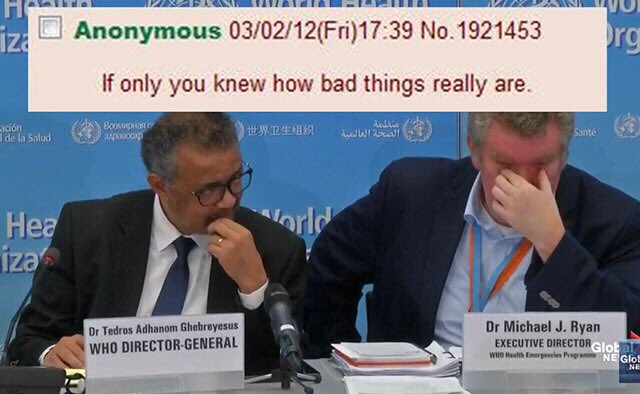
So — what’s an un-elected bureaucrat to do? At this point, it will help to remember that these are bureaucrats we’re dealing with, here — they’re not saints; they’re people, just like you and me, every bit as liable to fall for the allure of self-interest as any of those currently dodging symptom-checks at airports, hoarding toilet paper, or breaking their self-quarantines to attend public gatherings.

The answer to this problem, then, is simple, if only because it’s the last one left. Basically, you’re going to have to figure out a way of doing something — or at least, looking like you’re doing something — without actually doing much of anything at all. A necessary component of this strategy will entail that your organization consistently down-plays the nature of the risk that this virus poses to the world: so long as the public genuinely believes that there’s nothing to be worried about, they will not be demanding that you take any of the aforementioned, unsightly options.

That way, your overall lack-of-action will appear not irresponsible, but rather reasonable. As far as the WHO’s continued existence is concerned, it doesn’t really matter whether or not their actions (or lack thereof) really are irresponsible, only that they don’t look that way.

Herein lies the danger with putting a single organization in charge of public health on a global scale: like most UN agencies, the WHO is accountable only to itself, despite being charged with the health interests of (for all intents and purposes) the entire planet. If any of us have a problem with the way the WHO is governed, there is effectively nothing that we can do about it — not unless the WHO itself happens to agree with our concerns. Until that day comes, if it ever does, we remain entirely at their mercy.

Again, we must ask ourselves: what incentive do they have to agree with us? In fact, they have much more incentive to outright lie to us, lest their cushy office jobs be put on the chopping block. To an extent, I can understand the difficulty of their present situation: surely, it is no easy task to balance the needs, wants, and demands of some 8 billion people with the needs, wants, and demands of the politicians, bankers and bureaucrats signing your paychecks. I only say “to an extent” because — call me crazy — I don’t really care whether or not anyone gets to keep their cushy office job after the dust settles, and frankly, with so many lives at stake, I can’t understand why we haven’t yet seen at least one or two whistle-blowers emerge whom would presumably agree with me on this point.

To quote @DaveEncompas0 on Twitter, who summarizes the debacle quite nicely:

One of the most striking, morbid symptoms of this era is public institutions’ fixation on the interior, subjective strata of a public they seem to increasingly mistrust. The Managerial State’s surveillance of mind rises in proportion to its failure to attend to material reality. [source]

Indeed, in our present era of global oligarchy, public opinion is not the means of understanding and alleviating concern that it may have once been. Rather, it is a dangerous and institutionally life-threatening obstacle that must be overcome by any means necessary. And if you cannot — or, in this case, are perhaps not allowed to — combat the issue that has caused such negative public opinion, you are then forced to combat — or, in this case, distract from — the negative opinion itself.

*

The bulk of the preceding paragraphs were drafted prior to the WHO’s extremely belated, “official” designation of the novel coronavirus outbreak as a pandemic. Since then, the crisis has accelerated considerably: just one of many examples comes from the hard-hit nation of Italy, where hospitals are reportedly being forced to choose which incoming patients will be eligible to receive intensive, life-saving care, and which will be left to their fates. Parts of Spain and France are now on lock-down, and multiple nations have suspended both land and air-based travel into their territories, whether for travellers from specific regions or — as is the case in Denmark, Poland, and, quite ironically, a number of Central American nations — from anywhere else in the world. Even Canada, too, is now closing its borders to most, albeit not all, foreigners.

These are dark days indeed, and darker still remain. It may seem difficult to fathom at this stage, but we must remember that this, too, will pass. The day will come when our lives return to normal — though what appears to be “normal” to us on that day may be drastically different from what we would have considered “normal” before all of this began.

Although Canada has not yet initiated any large-scale lock-downs such as those seen in China, Italy, Spain, France, and parts of the United States, many of us will be spending much more time indoors, away from our jobs and other commitments, whether with our families or alone with our thoughts. As tempting as it may be, I think it would be a terrible shame to spend this sudden surplus of free time on fearing for the future. You will likely end up doing this to some extent, anyway — we’re only human, after all. My point is that you should try not to spend all of your time doing so.

At any rate, fear is far from the only emotion that you ought to be feeling at this moment. In particular, if you are not angry with the powers that be for having inflicted this mess upon you in the first place, I would urge you to reconsider.

Yes, we certainly have the right to be upset with the Chinese government for their bungled and haphazard response to the outbreak while it was still contained within their borders. We have just as much of a right to be upset with the WHO and their lackeys for having sacrificed our health and safety on the alter of money, power and “progress.” But do not forget that governments around the world — in all likelihood, yours included — consistently delayed putting the proper measures in place in time to protect you and your family from harm. That citizens all over the world are now being faced with widespread unemployment, uncertainty, and quarantine — mandatory or otherwise — on top of a very real and dangerous threat to their health, was not inevitable. If anonymous Twitter accounts and citizen journalists knew that this was a big deal as far back as early January, it’s a sure bet that our leaders knew as well, if not sooner. All the same, they did nothing.

None of this had to happen. Nearly all of this chaos, both coming and ongoing, could have been prevented. To re-iterate: calling this mere incompetence gives them far more credit than they deserve. It is not incompetence, but cold, calculated malice. Somewhere along the chain of command, a decision was made that your health did not matter nearly as much as your behavior — after all, dead men tell no tales.

God forbid that any of you reading this (or any of your loved ones) become ill with this terrible sickness. No matter who you are, whether you agree with my views or not, I sincerely hope that this virus passes by you and your family without incident. Though the coronavirus has done a better job at exposing the rotten foundations of our globalized economy and its complex, off-shored supply chains than all the thousands of hours of YouTube exposes on the topic combined, the last thing I’d want is for anyone to lose their lives in the process.

Sadly, lives have already been lost. All we can do now is to try to do our best to ensure that we do not lose any more. Do not trust your government to do this for you: remember that the only reason they are acting so swiftly at this stage is because the problem has become too big, too scary, to deflect with simple accusations of bigotry and intolerance.

Do not forget that, when you were afraid and desperate for answers, the government called you a ‘racist’ for having dared to ask questions.

I am not at all certain that our global elite will learn anything of value from this experience. In all likelihood, they will be itching to get back to “business as usual” as soon as possible — as ‘usual’ as it can be, at any rate. We must not allow them to do so. We have a responsibility to those whom have already suffered and perished from the consequences of these decisions to ensure that nothing like this ever happens again. And if we do not learn anything from this, mark my words, it will happen again.

To return to Dave’s quote: our institutions, both national and international, do not trust us. They do not trust us to make the appropriate decisions with the information they have on hand, and by withholding it, they have forced us to do whatever it is they think we should be doing, whether it is the right thing to do or not. The tragic results are now piling up in hospitals, morgues, and graveyards across the world.

Use this time wisely. Use the fear and anger you are feeling now just as wisely. They do not trust us, and we should make damn sure that the feeling remains mutual.

Do not forget who did this to us, and, most importantly, do not forget why.

The Palm Oil Paradox: Just One of Sustainable Agriculture’s Dirty Little Secrets

In terms of breadth and scale, perhaps the grandest of all the UN’s Food and Agriculture Organization (FAO)’s efforts in the interest of sustainable agriculture has been in the promotion and production of palm oil, a substance used in a variety of processed foods, as well as non-edible products and, to a lesser extent, as a source of biofuel. Of the countries involved in the palm oil industry, Indonesia heads the list as the top exporter, followed by Malaysia; together, the two countries produce 80% of all the world’s palm oil. [1] Elsewhere, the FAO has managed to introduce a more cold-resistant hybrid of palm tree to be grown in Kenya, which has seen encouraging results: “The potential of the hybrids is considerable,” the project’s website states. “Fruit can be harvested from three-year-old palms, and the palms reach maturity at about six years, if well tended. Mature palms yield about 20 tonnes of fresh fruit bunches per hectare a year, or 4 tonnes of oil. The palms’ productive life is about 25 years.” Moreover, we are told, the cultivation of palm oil is of ecological benefit: “Oil palm is environment-friendly,” according to one of the project’s “key technical officers,” Peter Griffee. “It doesn’t compete with native vegetation or food crops in western Kenya. There’s no need to turn the soil over every year, so there’s less erosion and soil compaction.” [2] But wherever it is grown, the cultivation of palm oil has been frequently touted by the FAO and others as a means of combating poverty, either by providing employment on large plantations to locals whom are needed for the labour intensive task of land-clearing and harvesting, or by its use as a cash crop for smaller, typically family-run farms. [3] In this respect, the enterprise might not sound like such a bad idea – so, where’s the catch?

Unfortunately, in the years since the aforementioned project, perspectives on the environmental-friendliness of palm oil production have shifted massively in the opposing direction. Writes Natasha Gilbert for Nature, “Palm oil was once touted as a social and environmental panacea — a sustainable food crop, a biofuel that could help to cut greenhouse-gas emissions and a route out of poverty for small-scale farmers.” However, more recent research would suggest that not only does large-scale production of the crop lead to “damaging deforestation” in the countries concerned, “the oil’s use as a biofuel offers only marginal benefits for mitigating climate change” — in fact, according to tests conducted by the United States Environmental Protection Agency, the use of biofuel emits just 11-17% less greenhouse gas emissions than diesel over an entire ‘life-cycle’ of use. [4] By all appearances, the environmental movement’s honeymoon with palm oil would seem to be over — within the industry itself, however, not everyone seems willing to let go.

The Roundtable on Sustainable Palm Oil (RSPO), a lobby group composed of various corporate stakeholders in the palm oil industry, seeks to “transform markets” and “make sustainable palm oil the norm” by leading the charge on standard-setting and monitoring of sustainable production practices within the industry. At the time of writing, the RSPO’s board of governors includes representatives of palm oil production and processing companies, in addition to those from the manufacturing and retail sectors, companies such as Unilever and Procter & Gamble, and other non-profit organizations like the WWF and the World Resources Institute (WRI). [5]

At any rate, they certainly have their work cut out for them. As alluded to previously, a great deal of the controversy that has emerged over the cultivation of palm oil trees has to do with the large amounts of natural forest that need to be cleared in order to make way for the plantations. This has consequences both for the ecological stability of an area as well as for its animal inhabitants, such as orangutans and other endangered species resident in Southeast Asia, where most of the world’s palm oil is produced. Furthermore, resident respondents in one survey of an oil-producing region in Malaysia expressed concerns that the processing mills in the area were polluting the local water supply, in addition to noting the loss of the natural forest as a valuable resource for hunting game and gathering wild fruits. [6] This latter development is of particular concern to the many households who did not own the land they customarily used for subsistence agriculture; due to the nature of Malaysian property laws, these families did not need to be consulted regarding the conversion of this land into plantations — indeed, as the researchers note, seventy-seven percent of the respondents were not given any advance warning, with the remainder being notified of the change by village authorities. As such, these households were now forced to rely much more on hunting and gathering within the shrinking forests as a main food source. [7] With all of this in mind, the picture becomes more complicated: is it possible to change the inner workings of the industry in a manner that reduces the negative effects of palm oil cultivation, as outlined above, while still retaining the positive benefits to local communities?

A cursory review of the RSPO’s “Principles and Criteria for Certification” for large-scale producers appears promising: contained therein are guidelines and indicators not only for ensuring better environmental practices, but as well for taking into consideration those households and communities that may be negatively affected by plantation activities, such as including them in consultations despite a legal lack of land ownership. On the other hand, and despite the RSPO having been founded in 2004, there are presently no similar standards or guidelines in place for smaller-scale operations — this is certainly problematic, considering that these ‘smallholder’ palm oil producers make up between 35-40% of the total plantation land in Indonesia and Malaysia alone. [8] Nevertheless, the mere existence of industry standards is surely a step in the right direction. Now, the question is whether or not these standards are being reliably enforced and upheld.

In November of 2012, the International Labour Rights Forum (ILRF), alongside the local NGO Sawit Watch, visited three RSPO-certified plantations in Indonesia with the hope of finding out just that. At all three locations, the field researchers spoke with workers who shared their experiences, from which many frightening commonalities began to emerge: low compensation for the amount and intensity of labour provided; parents having to bring their children with them to work on plantations in order to meet the set harvesting quotas; little or no job security or employee benefits in any respect; and overall poor and/or hazardous working conditions, including frequent exposure to corrosive chemicals without proper protective gear or, when needed, even basic medical care. One worker describes being lured to his place of employment with promises of a good salary and paid accommodation, only to discover on arrival that he would receive no housing, no food, and be paid considerably less than promised for work performed in extremely poor conditions — now, being unable to cover his family’s expenses and forced into taking on debt with the plantation’s on-site commissary, the man has no choice but to continue working there in order to pay it off. At a different site, a ‘casual’ worker (in essence, a labourer who is paid less than a permanent worker, receives no benefits, works unstable hours and may be fired at any time) claims that some of her fellow workers will attempt to bribe the site’s foreman with food and cigarettes in hopes that they will be selected to work a particular shift. [9] 

At the time of writing, only some of the abuses observed by Salit Watch and the ILRF appear to have been dealt with by the RSPO in any meaningful manner. Among the parent companies of the three plantations visited — Wilmar International, Socfin, and Salim Ivomas Pratama Tbk (SIMP) — only SIMP no longer appears on the RSPO’s roster of members. In this case, the ILRF and two other NGOs eventually filed a formal complaint with the RSPO over conditions discovered during yet another visit of the PT Lonsum plantation, one of the three investigated previously by the ILRF and Sawit Watch; a subsequent RSPO-led investigation of the site later confirmed their findings. Following the SIMP’s failure to meet the conditions of the decision rendered by the Complaints Panel, the RSPO terminated the company’s membership and nullified their certification in February 2019. [10] As for Socfin, at the time of writing there appear to have been no formal complaints lodged with the RSPO (according to their database) regarding labour practices on their plantations to date. [11]

Meanwhile, Wilmar International, one of the largest shareholders in the global palm oil industry, has continued to generate controversy in more recent years: a 2016 investigation by Amnesty International (AI) uncovered multiple instances of children on Wilmar-owned plantations engaged in labour contrary to both Indonesian and international law; this, too, seems to have resulted from the children’s parents being unable to meet their harvesting quotas without their assistance, which for some of the workers could mean a reduction in their pay, irrespective of the actual hours worked. As the report explains:

The targets that workers have to achieve are set by individual companies, and appear to be set arbitrarily to meet companies’ needs rather than being based on a realistic calculation of how much workers can do in their working hours. [ … ] Workers can face deductions of their salary for failing to meet their targets, in some cases leading to their salaries falling below the minimum wage, or lose out on ‘bonus’ payments despite working long hours in excess of the working hours limit. Workers are rarely paid overtime for extra hours worked. [12]

Some of the children interviewed claimed to have begun working on the plantations at as young as eight years old. [13] In a statement responding to the findings presented to them by AI, Wilmar claims to have taken all of the necessary steps to remind parents not to bring their children to work with them, and to conduct regular patrols for enforcement — but, as AI points out, this response entirely ignores “the impact of low wages and the use of targets and penalties for certain tasks as causative factors that lead to parents bringing their children to help them with work.” [14] Just as the previous investigation conducted by the ILRF and Sawit Watch had found, some of the sites surveyed did not bother providing proper training or protective gear to workers handling hazardous chemicals; in one instance, a worker described having been splashed in the eyes with a particularly strong herbicide, “leading to severe damage in her eye and optic nerve.” [15]

Not only is Wilmar still a member of the RSPO, a number of Wilmar’s customers are as well — two of them, Unilever and Procter & Gamble, as mentioned previously, sit on the RSPO’s board of directors. With this in mind, it seems quite unlikely that the RSPO’s internal governance is completely unaware of the multiple allegations of this nature that have been levied against Wilmar. What kind of implications do such revelations have, not only for the palm oil industry, but for the very notion of ‘sustainable agriculture’ more generally? The entire, central idea behind the group’s existence has been, ostensibly, to establish standards for sustainable business practices within the industry, and to certify those who have been deemed to meet them: if consumers are to willingly go out and purchase products stamped with the RSPO’s seal, they are doing so with the belief that nowhere along the production chain was the palm oil within the product produced in a manner that violates the sustainability mantra – which, we may reasonably assume, includes respect for labour laws and regulations, at the very least. As it presently stands, it appears that all such a seal provides is the justification for charging a higher price for the end-product — done properly, it is generally more expensive to manufacture products in a non-abusive (regarding both workers and the environment) manner, but this is of course hard for one to verify on the spot when considering whether or not to make a purchase; hence, the alleged point of RSPO certification to start with. With no enforcement of their own standards, however, consumers might well be better off purchasing an uncertified product at a lower price — if they’re being produced in the same, ‘unsustainable’ manner, what’s the point in paying more?

We might wonder how the UN feels about its sustainability ‘branding’ being appropriated by the RSPO for such dishonest and, frankly, downright abusive practices. Well, in 2014, the UNEP nevertheless signed a memorandum of understanding with the RSPO, aiming to “raise the global awareness of sustainable palm oil and generate market demand for an important commodity that has the potential to play a key role in preserving the Earth’s biodiversity.” Said the former Executive Director of the UNEP, Achim Steiner, in a press release, “The RSPO deserves our support in their commitment to produce palm oil sustainably.” [16] But if RSPO-certified companies continue to benefit directly from the exploitation of these workers, such an ‘understanding’ is effectively meaningless: all they are doing is trying to “generate market demand” for a phony product. Even if it were the case that every other RSPO-certified company adheres faithfully to the organization’s standards, this failure to adequately address the severe infractions committed by one of its most prominent members — Wilmar International — completely discredits the supposed value that such certification purports to generate. The sustainability brand, at least as far as the RSPO is concerned, appears to be just another form of marketing: a means of tricking consumers into purchasing products they believe to be more ethically produced, when it is in reality the exact same product in fancier, ‘sustainable’ packaging.

Notes & References

[1] Sonja Vermeulen and Nathalie Goad, Towards Better Practice in Smallholder Palm Oil Production, Natural Resource Issues Series No. 5 (London: International Institute for Environment and Development, 2006), 4.

[2] Teresa Buerkle, “Hybrid oil palms bear fruit in western Kenya,” FAO Newsroom, November 24, 2003, http://www.fao.org/english/newsroom/field/2003/1103_oilpalm.htm (accessed August 21, 2019).

[3] Vermeulen and Goad, Towards Better Practice, 10.

[4] Natasha Gilbert, “Palm-oil boom raises conservation concerns,” Nature 487, no. 7405 (July 5, 2012): 14-15.

[5] “Our Organization,” Roundtable on Sustainable Palm Oil, n.d., https://www.rspo.org/about/our-organisation (accessed August 21, 2019).

[6] A. A. B. Dayang Norwana, R. Kunjappan, M. Chin, G. Schoneveld, L. Potter and R. Andriani, The local impact of oil palm expansion in Malaysia: An assessment based on a case study in Sabah State, Working Paper 78 (Bogor, Indonesia: Center for International Forestry Research, 2011), 8.

[7] Ibid., 12-13.

[8] Vermeulen and Goad, Towards Better Practice, 8.

[9] International Labour Rights Forum and Sawit Watch, Empty Assurances (Washington, D.C.: ILRF, 2013).

[10] “RSPO Secretariat’s Statement on Complaints Panel Decision Regarding PT Salim Ivomas Pratama Tbk,” Roundtable on Sustainable Palm Oil, March 1, 2019, https://www.rspo.org/news-and-events/news/rspo-secretariats-statement-on-complaints-panel-decision-regarding-pt-salim-ivomas-pratama-tbk (accessed August 22, 2019).

[11] That said, according to American policy think tank The Oakland Institute, Socfin’s land-leasing practices have come under fire from locals in Sierra Leone. See: The Oakland Institute, Understanding Land Investment Deals in Africa: Socfin Land Investment in Sierra Leone (Oakland: The Oakland Institute, 2012).

[12] Amnesty International, The Great Palm Oil Scandal: Labour Abuses Behind Big Brand Names — Executive Summary (London: Amnesty International, 2016), 5.

[13] Ibid.

[14] Ibid., 6.

[15] Ibid., 8.

[16] “UNEP and Roundtable on Sustainable Palm Oil Sign New Agreement,” United Nations Environment Programme, November 14, 2014, https://www.unenvironment.org/news-and-stories/press-release/unep-and-roundtable-sustainable-palm-oil-sign-new-agreement (accessed August 22, 2019).

COP25: A Canary in the (Decommissioned) Coal Mine?

Just before Christmas, as COP25 wound down to a close, a fun little bit of light reading found it’s way into my inbox, courtesy of the International Institute for Sustainable Development’s mailing list. The article, titled “Deciding What to Think of the First Four Years of SDG Implementation,” tells us all a person really needs to know about the slow-motion car crash that some have taken to calling “climate politics”.

So — four years and several billions of dollars later, now appears to be the right time for our Green Overlords to take a step back and assess whether or not anything of value has resulted from these efforts. Thus, after decades of doing seemingly little more than publishing an endless slew of ‘reports’ on how nothing is getting done, it was apparently necessary to commission yet another of these reports for it to be recognized that this is not exactly what most might call a “winning strategy.” Of course, we need not get our hopes up that this particular report will have any more of an effect on the execution of said strategy than any of its predecessors.

Provided the reader is at least somewhat familiar with the type of people we’re dealing with, here, the results — or rather, lack thereof — ought to come as little surprise: “[W]ith a few exceptions,” we are told, “[the] SDGs have very rarely been used to challenge practices, and have not triggered the transformative project they promised.” Say it ain’t so!

Moreover, “It must be acknowledged that the adoption of such an ambitious agreement was possible only because it does not require concessions or a change in behavior from anyone in particular.” Indeed, it is much easier to talk a big game than it is to play it — an important lesson that most of us have internalized before puberty. One has to wonder why those who seem the least familiar with the basic tenets of human nature nevertheless see themselves fit to micromanage all of humanity.

It isn’t all bad news, though — the report notes that the SDGs have been name-dropped by various politicians and diplomats more frequently in 2019 than they had been in previous years. If only we lived in the fictional universe of Beetlejuice, and all you had to do was say “sustainable development” three times fast and then — Poof! — results! We’d have reached the promised utopia decades ago!

In all seriousness, the bulk of the report is seriously unimpressive. As jaded as I’ve become over this last year of closely following the implementation of Agenda 2030, it is difficult to read its contents as anything but the typical, desperate attempt to blame its numerous failures and setbacks on the scarecrow issues of “lacking commitment” and “reduced financial flows.” Perhaps they have yet to realize — or, perhaps, have yet to accept — that it is difficult to retain much of any commitment, financial or otherwise, to a project that is fundamentally impossible to implement.

If no other lessons have been learned these last four years, it’s that there is a limit to how quickly and radically one may attempt to alter a given society without facing considerable consequences for having done so. Emmanuel Macron may be willing to chance massive protests, walk-outs, even rioting directed against the many unfavorable policies he has imposed upon the French people, but even he seems capable of determining which lines are better left uncrossed. UN bureaucrats, of course, none of whom were properly elected to their positions and all of whom remain entirely unaccountable to any authority not under the UN banner, clearly have yet to come to a similar understanding.

As such, it is somewhat poetic that not only did the COP25 proceedings end up being moved from their original location Chile, partially (albeit not entirely) as a result of UN-backed fiscal shenanigans in the region, but as well that the conference ultimately ended in a colossal failure. Not only did the attendees fail to produce any form of agreement on the conference’s biggest issues, such as the Green Climate Fund; it would appear that both worldwide CO2 emissions and coal extraction are — get this — increasing still (if you enjoy watching the climate cartel circling the drain as much as I do, see Francis Menton’s takedown of the situation here)! In either respect, we largely have the Chinese to thank: after a long period of courtship between the People’s Republic and the UNEP, particularly in the field of mass surveillance technology and methods of behavioral control (previously covered here), it seems now that the PRC has lost interest, at least temporarily, in maintaining this long-standing charade of ‘consensus’ — at least, as far as shuttering the nation’s resource industry is concerned.

And why would the Chinese government do such a thing? Clearly, because they seem to think this whole ‘climate crisis’ business — increasingly, a ‘business’ in the literal sense — is to some extent a crock of nonsense. Where would they get such an idea from, I wonder? Maybe from the Indian government, which has similarly made clear its intent to worry about things like infrastructure development and the provision of electricity first, climate mitigation second — “conditional on higher financial support from developed nations,” of course. At any rate, both India and China are joined by a handful of African nations in declaring themselves to be far more concerned with the real and immediate concerns of their own nations than they are with some sinking, sparsely-populated islands in the middle of the Pacific. And fair enough, some might say — after all, China and India are home to the first- and second-largest populations on the planet, and current projections have the African continent set to double its own population by 2050. It therefore seems difficult to really blame any of these actors for not wanting to shoulder the burdens of any more people than they already have to deal with — this, of course, goes directly against the core pillars of globalism, which would greatly prefer to see every single person on the planet equally suffer the consequences incurred by the actions of just a few.

Predictably, much of the moaning emitted from UN HQ thus far has instead had to do with the United States’ dropping out of the Paris Accords; likely, I would imagine, because it is easier from a public-relations perspective to accuse America of calculated sabotage than it is to admit to having been played for fools by China. But no matter which particular country (or sets thereof) we’d like to point our fingers at, all roads of inquiry lead back to the UN. Perhaps the real question to be asked is this — just how much longer can this show go on?

***

I first started this blog as something of a ‘companion’ outlet to a book I was (and still am) writing about the development industry, particularly regarding the attempted implementation of Agenda 2030. Naturally, the ‘unholy’ institutional trilogy of said industry — the UN System, the IMF, and the World Bank Group — featured quite heavily throughout, as did the innumerable hair-brained schemes and scams concocted by them in the grand pursuit of an allegedly-better world. Over time, my sights were trained on exactly how these organizations came into being, both materially and intellectually; later still, I became quite concerned with understanding why such a clearly corrupt and self-interested network of bureaucracies ever came to be seen as a legitimate force for ‘good’ in the eyes of the public in the first place, considering all the many reasons said public has been given not to trust them, practically since this whole mess started back in 1945.

And now, I am beginning to realize what a mistake it was to believe that all of this really started as late as 1945. Today, it seems to me that in order to truly understand the many problems that we presently face — as individuals, as societies, and indeed, as a species — it may well be necessary to wind the clock of inquiry back to the onset of the Industrial Revolution. Much like Rome, this self-cannibalizing system of ours was not built in a day; rather, it was slowly constructed over the course of at least a century, maybe even two. “Thankfully” — depending on one’s personal outlook on things — it can all come crashing down much more quickly than that.

Soon after beginning this project, I came to the belief that the UN et al. would never live to see the completion of its driving vision. This was based in the sincere observation that it is literally impossible to attain a number of their stated goals — as just one example, the World Bank’s latest initiative to score a given country’s rate of “learning poverty” based on its proportion of literate ten year-olds goes completely against everything we presently understand about both literacy and our present (in-)ability to test such things in a reliably standardized manner — as well as that it is logistically impossible to carry out a majority of the others. Thus, my main concern was with regards to the lengths to which the UN et al. and its supporters might go in the pursuit of carrying it all out anyway — in other words, I was more worried about the journey toward this utopia than I was about ‘discovering’ we’d been lied to about it on arrival.

My initial research for this project began around October of last year; the actual writing of it began the following January. Thus, around a year after having started all of this, the passage of time and the revelations accompanying it have necessitated that I revise my outlook.

In essence, I no longer believe that the UN will live to see the year 2050, let alone the completion of any projects that they might’ve liked to see done by then. As a matter of fact, I’m not convinced that the UN will live to see the year 2030: if it does still exist in ten years, I find it highly doubtful that the organization will retain anywhere near the same level of authority and influence that it enjoys at present. Indeed, since 2015 the entire UN System has been rattled by a dramatic decrease in perceived legitimacy; should this trend continue over the next five years, that the UN would become essentially defunct (or at least powerless) at some point during the next ten years seems practically inevitable.

By all accounts, such a thing would be a blessing. Yet there still remains the aforementioned problems of figuring out how and why we got ourselves into the position of cheering on the UN’s decline in the first place. I am greatly concerned that, without proper insight into the mistakes we’ve made in the past and present, we run the risk of repeating those same mistakes in the future. The absolute last thing I’d want out of this would be to see the UN shuttered, only to be replaced by an ideological carbon-copy differing only in the level of enthusiasm displayed by its proponents. Put simply, if the UN is going down, I want to make sure that it’s down for good.

Going into the new year — and a new decade — my plan is as follows: I am presently sitting on more than two-hundred pages worth of research and analyses conducted for the purpose of trying to “take down” the UN. Now that I see the UN might very well take down itself (and, accordingly, that my attention may be of better use elsewhere), it would be a shame for all this time and effort to have gone to waste. As such, my goal will be to transform this research into blog and/or video-friendly formats, as I work on re-writing the book through a more ‘philosophical’ lens.

At the same time, I would like to branch out a bit in terms of the topics covered on this blog. Specifically, I would like to focus somewhat less on the material aspects of our situation — the economics, the statistics, the projections — and more so on the immaterial, perhaps even ‘spiritual’ wasteland that presently characterizes Western life, particularly in pop culture and media. Whether we like it or not, in this day and age it is indeed through this medium that a majority of people come to understand the nature of the world around them — thus, the cultural landscape appears, to me, as a wide, open threshold, simply waiting to be crossed. Given that my own educational background and training is, in fact, in culture, ethnography, and semiotics — rather than in green energy or digital finance, which has nevertheless characterized much of my content to date — this is an important discussion that I feel quite capable of meaningfully contributing to. Indeed, I feel as if I have something of a duty to do so.

In closing, I want to thank everyone who has been reading, sharing, and (hopefully) getting some use out of my content to date. It has been your overwhelmingly positive feedback that has given me the drive to keep going with this project, and I am truly, immensely grateful for all your support. This past year has been quite the wild ride, and I very much look forward to seeing where it takes us next.

Best wishes to you and yours in the New Year,

A. E.

A World United in Discontent

On October the 26th, what began as a student-led rebellion against a rise in metro fares culminated in more than a million Chileans across the country hitting the streets in a more general protest of rising wealth inequality — already the worst in Latin America — in addition to low wages, increased costs of living, poor public health care and what they see as a massively outdated and ineffective pension system. [1] Further north, in Ecuador, widespread civil unrest erupted earlier that month, following the government’s decision to end a long-standing fuel subsidy and the subsequent, dramatic rise in pump prices rocking the oil-producing nation. [2] Across the Atlantic, meanwhile, the Netherlands has played host to considerably less-violent, yet no less disruptive, traffic-blocking protests by farmers in rejection of a recent government proposal to slash Dutch agricultural production by some 50%. [3] And then, of course, there’s the French, who will celebrate a full year’s worth of weekly demonstrations against various government policies, not least including their own eco-tax on fossil fuels, this upcoming Saturday.

In all four cases, what we are witnessing is a clash between two worlds, and between the vastly differing sets of expectations that accompany them each. In the blue corner, we have the pseudo-Nirvana of Unlimited Progress and the transnational elites whom champion it; in the red corner, we see the great masses of humanity whom have become keenly aware that this vision of the Anointed Ones has been tailor-made to exclude the common folk. Caught in the middle of the conflict we find the national and sub-national contractors tasked with the dirty work of our enforced enlightenment: the politicians, the civil servants, mainstream media and the cultural industry; all eager to play the part of the dodgy referee.

And while so many remain captivated by the action in the ring, a number of fist-fights have broken out in the stands. Of particular interest to us is the ongoing scrap between the two ‘halves’ of Canada, East and West, the more vocal members of each having accused the other of rooting for the wrong contender. Insults are tossed two-and-fro at a breathtaking pace; it has become something of a chore by this stage to keep up with who has called whom what, and why. The minute it appears that tensions between the two factions may begin to thaw, someone is sure to remember some thing or another that someone else might have said, or done, or even suggested, at any point between 20 minutes and 20 years prior to now, and to lob this painful memory like a grenade in the direction of the opposing side. And just like that, the fighting resumes before the smoke has had time to clear.

At some point, however, we’ll need to ask ourselves if this brawl is not itself a mere imitation of the main event we’re ostensibly spectating. Are these regional fractures of ours deepening solely as a result of the numerous, longstanding grievances between us emerging from the shadows once more, or is this simply the mask that we, as Canadians, have decided to don before we, too, step into the arena below? Of course, it is more than likely to be a mixture of the two — surely, many of the students in Chile who first began hopping turnstiles at train stations might have been happy to leave the protests there, and none of them could have predicted that this relatively mild act of opposition would later explode into the much more intense, much more generalized rage against the state machinery now wrestling the country into a choke-hold. But no matter how exactly the fighting might have kicked off, it has now taken on a life and character of its own — there’s no going back now.

Perhaps we Canadians share much the same fate: considering that the rise in Chilean metro fares was, among other factors, instigated by fuel prices [4], and that highly similar concerns have been behind the concurrent unrest in France and Ecuador (the Dutch farmers, meanwhile, can look to the same source behind their woes as can those waging war against high fuel prices — the alleged ‘climate crisis’), it seems only natural that the particular region of Canada dependent on a functioning fossil fuel industry would make the most noise in the face of an administration seemingly hell-bent on following the example set by its French and Ecuadorian counterparts.

But with violent demonstrations, looting, and rampant civil disorder not quite being our thing in Canada, and with the country itself being tens of times larger than all of the aforementioned nations put together, it is perhaps just as natural that our own brand of discontent would manifest itself in a spatially grandiose manner — that is to say, in the form of a burgeoning separatist movement. More to the point, however, one does not have to necessarily agree with the notion of a ‘Western Exit’ to be capable of recognizing the genuine reasons behind its very existence: simply put, it is about pipelines in Alberta — but it doesn’t stop there. Likewise, it is about metro fares in Chile, about fuel taxes in France, about fuel subsidies in Ecuador and about farming quotas in the Netherlands — but in none of these cases do things stop ‘there’, either.

Because as deeply personal as this spat between East and West may feel to us as Canadians, these present hostilities do not exist, nor were created, in a vacuum. Yes, the arguments we use, the names we call each other, and the historical grievances we point to, will all be adorned with our own unique, contextual flair. But we’d be fools to believe that we are the only nation presently tearing itself apart at the seams, and nor should we believe it possible to somehow turn back the clock on all of this and go back to the way things were ‘before’ — whenever we wish that to be.

Much the same can be said for the rest of the world: the cat, as it were, is no longer anywhere near the bag. It has become starkly visible to the citizens of these countries, as well as many others, that the powers that be do not truly have their subjects’ best interests in mind; not only that, these millions of people have realized, in their own ways, the futility behind attempting to root out this problem at the ballot box. The culpable actors cannot be voted out, for so many of them are complicit in these plans that there will always be another around to fill any vacancies. They cannot be held accountable for any of their crimes, no matter the degree of evidence available, because they have given themselves the power to be accountable to no one other than themselves. Thus the people have turned to perhaps the last available and viable method of voicing their opposition: protesting, be it peacefully or otherwise. For many of us in Western Canada, surfing the tide of separatist sentiment — regardless of how realistic the thought may or may not be in practice — appears to be the only meaningful form of protest left at our disposal.

In the grand scheme of things, that this division of ours would crop up along regional lines is simply a consequence of both our size and the distribution of our comparatively miniature population. Truly, it is not the case that the English-speaking Canadians in the West are inherently, drastically different than those in the East, culturally-speaking or otherwise, and there are surely many on either side who may feel they have more in common with those on the other. Rather, we should not view it as a mere coincidence that the catalyst for this split happens to be very much the same in spirit as that behind many of the other ‘uprisings’ taking place across the globe: the clash between two worlds, as represented by the ongoing war on fossil fuels; between that of the (trans-)national elites and that of, broadly speaking, just about everyone else.

Of course, not everyone will agree with my view of the situation, nor would I expect them to. There are those who will contend that Western separation is far from a novel idea, and that its re-emergence was an inevitability independent of whatever happens in any other country. Others may counter that if our present conflict isn’t really based in what region of the country one happens to live in, then the whole argument for separation becomes something of a moot point. I can only ask that they consider the broader perspective: Canadians in the West may be asking for independence in a literal sense, but they are doing so at a time when so many others worldwide are asking for a more metaphysical form of independence — independence from government interference with their lives — and for many of the same reasons. Put differently, we might say that they are seeking out the latter ‘type’ of independence by means of demanding the former. But more importantly, because the roots of this current round of Western alienation are not, truly, unique to Western Canada, this is not a phenomenon that can be dealt with by any single act of concession. Yes, it is about pipelines — but it doesn’t stop there.

From the Inside, Looking Out

So, here’s the thing.

I, like many Canadians, had for many years bought into the widespread misconception of democratic governance constituting some kind of political ‘end-state’; some pinnacle of societal achievement, in no need of further perfection and essentially impervious to most threats, such that it could be brought down only by a sudden disaster of an exceptional character and/or foreign occupation by a non-democratic state. Without even knowing his name or his record, I had nevertheless managed to fully imbibe Francis Fukuyama’s theory of “the end of history”, wherein governance by liberal democracy appears virtually synonymous with the attainment of a society-wide state of nirvana. Fukuyama has long since walked back this claim in a variety of ways, but this particular myth appears to pervade ostensibly liberal, democratic societies to this day, and perhaps has even been doing so since long before Fukuyama first put the phenomenon into writing.

Partly owing to this blessed ignorance of mine, for many years I had no reason to feel as if anything bad was happening in my own, liberal democracy. I went on to spend five years in university learning from, and speaking to, people who were experts on the subject of tyranny — if not because they had studied the topic for years, then because they themselves had lived through the experience. Even before this, I have always been drawn to literature, fictional or otherwise, first- or second-hand, dealing with the stories of those people unfortunate enough to have to try living under an oppressive and hostile state regime. I always wanted to know how things could ever get to that point — surely, one does not simply wake up one day and suddenly realize that something has gone horribly wrong. There must be warning signs; events and circumstances that might indicate the devious direction one’s country is headed towards.

All the while, my interest in such things had something of a voyeuristic aspect to it. As much as I shuddered to think of what I would have — or could have — have done in a similar situation, my musings on the matter were only slightly less ignorant than those that could be offered by someone with decidedly less interest on the topic. One way or the other, all of the first-hand tales in the world could not change the fact that I, myself, had never been in such circumstances. Crucially, this allowed me to retain a degree of separation from the horrible realities that others had endured; it did not, I believed, ever have to enter my reality. After all, it was not my brother who was dragged, kicking and screaming, out of his apartment building at three in the morning, never to be seen again. It was not my father who was shot in front of his family for refusing to hand over his farming equipment. And above all, it was not me who had to live with the memory of these things; who could vividly re-tell the events contained within, as if they had happened yesterday; who would never be able to forget them, even if I wished to do so. Though the empathy I felt for their suffering may have been genuine, their sorrow was not truly my burden to bear: I could leave this re-constructed world of terror at any point, and return to the one that did not scare me quite so much. Ultimately, I had the choice not to think about those things.

A lot of things have changed, since then. I’m no longer sure when it first was that I realized there was something rotten about the state of Canada. Certainly, it was some time around the Indian Voyage fiasco early last year that I knew for sure the country was not being led by our best and brightest. By then, the trans-Atlantic network of suspiciously well-dressed and well-fed “refugees” flowing between New York state and the Quebec border had been quite well established; this had made me angry at the time, so perhaps the end of my optimism had come even sooner than the India trip. I don’t really remember, but it doesn’t matter either way.

Fast forward to this past week. On Wednesday, a journalist, who is by no means a stranger to his seasoned colleagues whom hail from other news outlets, was repeatedly denied access to the Liberal Party campaign bus, on the alleged basis of not having the proper accreditation as a member of the media. This rationale works well as a cover-story to the public ear, because most members of the general public are not aware that accreditation is nothing like a process of “certification” or even “licencing”; rather, it is the simple act of demonstrating that one has contributed content to the news media in some manner (i.e., is a journalist), and receiving a slip of paper meant to serve as recognition of that fact. That’s it. For someone such as this particular journalist, accreditation is only a Google search away.

Of course, that’s not what happened. Effectively, this journalist was denied accreditation to board the bus, on the basis of not having accreditation to board the bus. As his colleague explains, “This is the equivalent of showing up at the DMV to get a driver’s license and them telling you that they can’t give a license because you’re not a licensed driver” — a perfect Catch-22. As the story goes, this journalist was later detained by police for following behind the bus by car; he says he had no choice but to do this, as none of the journalists who were on the bus, much less the campaign war room, were willing to tell him or his outlet where it would be pulling over next. This, in a country where, provided you meet the appropriate racial description, you can shove your hand down the pants of a 14 year-old girl and get away with it — don’t try to follow the Liberal campaign bus, though, because the police will get right on that! Later, on the other side of the country, he was denied entry (again, by local police) into a public building where a Liberal campaign event was taking place — not as a member of the media, mind you, but as an ordinary, curious member of the electorate. Just like you and me.

One of the other things I have always wondered about tyrannies of the past is whether or not a substantial part of the population was ever on board with it. Surely, one would expect that many would be made to go along with the narrative; but were there any among them who genuinely bought into the lies they were peddling? Depending on the particular regime, the answer to this varies considerably — sometimes, yes; other times, no. At any rate, most are not permitted the space to openly voice any disagreement, and the general public is left only to wonder.

Well, as it turns out, there is something to be said for the power of denial. Witnessing the passionate creativity with which any and all concerns regarding the legality, credibility, or indeed the necessity of the events outlined above have been effortlessly cast-aside by multiple members of the public, is truly a sight to behold. It’s the kind of mental run-around that could only be successfully orchestrated by those who really ought to know better — which is why I call it denial, rather than pure ignorance.

In all fairness, I can understand where they’re coming from: this land, our land, is not supposed to be a place where those things happen. Thus, there has to be some legitimate reason to refuse a journalist — conspicuously, one belonging to one of the few genuinely right-wing media outlets that remain in this country — entry to Liberal campaign events — right? There simply must be some kind of explanation for this. Because, if it turns out that there isn’t one, then that means that we live in a country where the ruling party can prevent a credible member of this press from covering their campaign events during an election, simply because there is a high chance that said journalist will disagree with the party’s position; maybe even in written form. Which, if it were true, would imply that we really, really don’t have such a thing as a free press in Canada. And that just can’t be the case — right?

Right?

No — you know what? That journalist can’t be a “real” journalist if he wasn’t allowed to cover the Liberal campaign. Maybe that’s it. Maybe, he was a journalist at some point, but he isn’t now. I’m not really sure how that would be determined beyond the aforementioned accreditation system, but surely the sitting party has a reliable way of doing it — this is their job, after all; who are we to question their performance? And, you know, even if the NDP thought his credentials were good enough to cover their campaign events, that doesn’t mean that the Liberals didn’t make the right decision — different party, different policy. What do we really know about any of this? We didn’t see how he was driving — maybe they were worried about being followed by a car. That’s reasonable, isn’t it? After all, some very important people were on board that bus; their safety really ought to come first. Maybe, then, they figured the guy was trouble when he tried to enter a different event as a member of the public, and they denied him entry just to be on the safe side. I mean, we really should be asking why this “journalist” was so persistent in the first place: do you really have to ask the Prime Minister questions, like, that badly? Like, come on, man; just do what you’re told and stop causing problems.

Right, so, there’s nothing really amiss here. This guy is just salty that he wasn’t allowed in, and he’s probably exaggerating the details because of that. That makes sense — much more sense than his version of the story, where he wasn’t allowed on the bus “just because.” None of this really means anything, then. No need to be upset. No need to fan the flames any further; we really ought to just forget about the whole thing. That sounds reasonable, doesn’t it? Let’s not worry about it anymore.

We still live in a liberal democracy — this is Canada, after all. The true north, strong and free. There’s no tyranny in Canada, nor should we ever expect it. Anyone who tells you otherwise is just trying to cause trouble, so it’s best to ignore them. Things really aren’t that bad here.

…right?

In truth, I don’t know. I don’t like any of this; I don’t like where we’re heading, and I don’t really like to imagine what could happen further down the road. I would rather not try to speculate as to how it could get that bad here, or what that would mean, or what it might look like. In fact, I would rather not think about those things at all. Now’s about the time that I would really, really like to go back to playing the role of an audience member, to be observing the events of someone else’s world, and not be a part of it myself.

If only I still had the choice.

COMMENTARY: “Uh-oh: Silicon Valley is building a Chinese-style social credit system” by Mike Elgan

At long last, someone in the (relatively) mainstream media is talking about what I’ve been warning of on this blog for the last couple of months — China’s social credit system, coming to a smartphone application near you. Elgan’s article does not cover the totalitarian coup de gras, however — this being the addition of “carbon conscious” behavioral nudges, in between all the ‘regular’ ones — but in all fairness, it may be a little too early in the “normie sphere” of understanding the world to introduce the concept just yet. Wouldn’t want to freak people out, right?

Just for review, Elgan describes the current Chinese model off helicopter-governing as follows:

In place since 2014, the social credit system is a work in progress that could evolve by next year into a single, nationwide point system for all Chinese citizens, akin to a financial credit score. It aims to punish for transgressions that can include membership in or support for the Falun Gong or Tibetan Buddhism, failure to pay debts, excessive video gaming, criticizing the government, late payments, failing to sweep the sidewalk in front of your store or house, smoking or playing loud music on trains, jaywalking, and other actions deemed illegal or unacceptable by the Chinese government [emphasis added].

So, you see, the system already goes far beyond the level of suppressing political dissent and/or enforcing the law, however draconian: “unacceptable” behaviors are now deemed to include excessive video gaming (how this is defined is, of course, for the government to know and the citizens to find out) and being rude in public. Again — it is really not that far of a leap between these current standards and the incoming, “green behavior” standards as are to be set by the United Nations Environment Programme (UNEP). “Failing to properly sort recyclables” would not look out of place on the above list in the slightest.

And what are the punishments to be bestowed upon those who transgress the credit system?

Punishments can be harsh, including bans on leaving the country, using public transportation, checking into hotels, hiring for high-visibility jobs, or acceptance of children to private schools. It can also result in slower internet connections and social stigmatization in the form of registration on a public blacklist [emphasis added].

I find the potential restrictions on movement to be of the most concern, here: the Chinese public may very well be used to it, at this point; but imagine if such a system were to come into place over here, in the West? You could be slowly wasting away in an economic dumpster-fire of a state — California, perhaps — and yet be unable to move residence owing to your failure to pick up enough litter to satisfy some arbitrarily-set quota. You would be, in essence, held captive in your present location until you were able to ‘absolve’ yourself of your ‘crimes’ — even if you no longer had any form of employment there, or a roof under your head.

Before brushing off this thought as unnecessarily alarmist, consider for a moment just how quickly things could spiral under control: you could be barred from public transit because you spent too much of your free time gaming. If you happen to rely on public transit to get to and from work, you’re in trouble: you’ll need to either find some longer or more expensive way to get to work, which could then leave you with too little time left over to complete your other, Good Citizen duties or, failing that, too little money left over at the end of the month to sustain yourself as before. Even if you can find work closer to home, you may have to accept lower pay or poorer benefits — one way or another, the point is that the system is set up to make it harder to attempt to clear one’s credit score the more infractions that are committed. As such, you have quite a bit of incentive to avoid gaming “too much” in the first place, lest you end up in a life-ruining spiral of trying to redeem yourself with even less ability to do so than you started off with — and this is just regarding freedom of movement; never mind all of the other punishments that are sure to exist.

The above scenario may be speculative for now, but we might not have to speculate for much longer — the article goes on to list a number of social credit-esque programs currently in use in the United States and elsewhere. I suppose not even the “free market economy” can save us from mass surveillance. The examples provided here deal with life insurance (companies monitoring your social media content to determine your premiums); scanning IDs at bars to check the individual against a blacklist of those who have been barred by other, participating businesses in the past — but, as the article says, “Judgment about what kind of behavior qualifies for inclusion on a PatronScan list is up to the bar owners and managers,” meaning that the system could be used abusively, in theory; in addition to those of Uber, AirBnB, and Whatsapp, all of which reserve the right to ban users for any reason they see fit to (or, in the case of Whatsapp, if “too many” users block you). When it comes to Uber and AirBnB, I’m not as concerned with the capacity for arbitrary bans only because neither company holds a monopoly over their respective markets — it may be more expensive to take a regular tax or to rent a regular hotel room, but it is not the same as being barred outright from doing either. That said, we should be worried by the potential for targeted mass-blocking campaigns (which would be similar to targeted mass-reporting campaigns currently in use on Twitter) to get someone kicked off of Whatsapp: as noted in the article the app is “small potatoes” in the United States, but the main form of electronic communication in many, many other countries worldwide.

Wrapping things up, the author does a great job of explaining what, if anything, people need to be concerned about when it comes to this form of social engineering:

The most disturbing attribute of a social credit system is not that it’s invasive, but that it’s extralegal. Crimes are punished outside the legal system, which means no presumption of innocence, no legal representation, no judge, no jury, and often no appeal. In other words, it’s an alternative legal system where the accused have fewer rights.

Precisely: carrying on with the example of excess video gaming, perhaps it won’t ever become illegal, technically speaking, for one to do so; but if people are being actively and effectively punished for their actions, it won’t have to be. And if it’s not illegal, the public has very few options available for getting things to change — we don’t get to elect board CEOs or hold referendums on changes to terms of services, after all.

Elgan continues:

If current trends hold, it’s possible that in the future a majority of misdemeanors and even some felonies will be punished not by Washington, D.C., but by Silicon Valley. It’s a slippery slope away from democracy and toward corporatocracy.

In other words, in the future, law enforcement may be determined less by the Constitution and legal code, and more by end-user license agreements.

Considering the now well-known biases and tendencies of American tech companies, the frightening possibilities are endless. If Google’s search engine can hide certain search results or prioritize some links over others, according to the company’s internal, politically-set mandate, could they hide businesses owned by people with poor social credit scores from Google Maps? Could Facebook find a way to penalize users in real-time for having the ‘wrong’ people on their friends list? To repeat: none of the above discussion even touches upon what the UNEP wants to do to encourage “green behavior,” and given the aforementioned biases in the tech industry, it’s hard to imagine that they wouldn’t willingly comply with requests to monitor users’ “carbon footprints.”

So, if you’re worried about the prospects now, I’m sorry to say that there’s only going to be even more to worry about in the near future. Sadly, there’s not much that can be done about it at this stage, aside from delaying the inevitable: basically, my advice would be to boycott businesses that use the aforementioned monitoring tactics to the greatest extent that you can. In this game of behavioral control, the only way to win is to not play.

Full article at: https://www.fastcompany.com/90394048/uh-oh-silicon-valley-is-building-a-chinese-style-social-credit-system

Save the Planet: Eat a Maggot

If you’ve not already come to terms with the existence of this particular UN-led initiative, I can understand why you might be hesitant to entertain the thought of it. You might be thinking, surely, this is a step too far? Maybe you’re willing to believe me when I write about the UN Environmental Programme (UNEP)’s promotion of Chinese smartphone apps to encourage “green behaviors”, or even the honest suggestion of brainwashing schoolchildren into becoming climate doomsday prophets for the purpose of converting their naysayer parents. Or, maybe you’re already aware of the UN’s consistent urging us to eat less meat in the name of mitigating greenhouse gas emissions produced by livestock — but do they really want us to eat insects instead of beef?

Ladies and gentlemen, this is not a drill. Here’s the front page for the Food and Agriculture Organization (FAO) of the United Nations’s Edible Insects Programme. You can download their flagship publication, from which I will be quoting extensively in this post, by clicking here. And, if you’re still unconvinced that this is a real initiative that the UNEP, FAO and World Food Programme (WFP) are seriously funding and promoting, here’s a bunch of recent, mainstream news articles on the subject of bug-eating:

Ottawa Citizen, July 18/19: “Maggots are the answer to feeding a human population that’s heading to nine billion people.”

Miami Herald, June 25/19: “Are bugs the next sushi? Insect meat will be $8-billion business soon, report says.”

Brisbane Times, May 2/19: “The researcher who wants Australians to eat a maggot sausage.”

Digital Journal, July 16/19: “Seeking an insect superfood? Grasshoppers top the list.”

And, for the pet owners out there — BBC, January 10/19: “Climate change: Will insect-eating dogs help?”

Take as much time as you need to go through these links: breathe it all in, and get back to me. We’re about to embark on a wild ride.

Now, if you follow me on Twitter, you might have noticed my tendency to re-tweet pretty much any article on this subject that appears on my timeline. I have one, main reason for this seeming obsession with the UN’s maggot-meat initiative: this particular globalist project serves to demonstrate just how far these people are willing to go in terms of controlling our lives; a realization that greatly benefits from it’s coverage in “regular”, mainstream media outlets. Things like the proposed reduction of global living standards to pre-industrial levels, mandatory contraception, banning private ownership of cars, etc., are much harder to expose to the general public owing to, putting it bluntly, just how bat-shit insane they sound — and, if we’re being honest, I can’t say that I blame them. Furthermore, only the banning of private cars has received MSM attention to date, the remaining proposals must be found via dedicated review of UN publications and documents. Eating bugs, on the other hand, lacks this “conspiratorial” aura due to the media’s willing compliance in promoting the ever-living hell out of the idea.

But why — aside from the obvious — eat bugs, specifically? Why not eat any of the number of meat-substitute products that have coincidentally become available at practically every major fast food chain across the West, and are now surely available at your own local grocer to boot? Why not do as the vegans have done and switch over to tofu, nuts and vitamin supplements? Hell, much of the ire levied toward meat consumption these days is aimed at the GhG-costs associated with rearing livestock (i.e. pigs, cows, etc.) — but what about poultry and eggs? Surely, we are not (yet) in a position where insects are the only reliable source of protein left — so what gives?

Well, as I should have come to expect considering my investigative experience with the United Nations’ wacky schemes up to this date, the real meat of the issue (if I may) goes much, much deeper than what can be seen on the surface. Thus, in order to understand the bigger picture, we need to lay some ground-work: first, we need to understand the UN’s particular role to play in dictating the new path to be taken by the world’s “food-systems infrastructure”; second, we need to look deeper into why meat has been identified as a problem-item on this new-and-improved menu; then, and only then, will we be able to at least try to wrap our heads around exactly how on Earth insects, of all things, came to be pushed so heavily as an appropriate substitute for meat.

The UNEP, the UNDP, the FAO, and your refrigerator

To start with, we might recall that the second Sustainable Development Goal (SDG) of Agenda 2030 is that of “zero hunger” — more specifically, the goal is, by the year 2030, to “end hunger and ensure access by all people [ … ] to safe, nutritious and sufficient food all year round;” “end all forms of malnutrition, including achieving, by 2025, the internationally agreed targets on stunting and wasting in children under 5 years of age;” “double the agricultural productivity and incomes of small-scale food producers [ … ] including through secure and equal access to land, other productive resources and inputs, knowledge, financial services [ … ];” “ensure sustainable food production systems and implement resilient agricultural practices that increase productivity and production, that help maintain ecosystems, that strengthen capacity for adaptation to climate change” (United Nations, 2015: 17) … there are another four ‘indicators’ listed under this goal, but those just listed are the most relevant for our purposes.

Well, as can be reasonably expected when it comes to the highly-contradictory SDGs, it is once again at the intersection of “people” and “planet” where we begin to run into trouble. Just as an aside, given that the UN doesn’t care much to address the issue of government and/or local-elite corruption and exploitation of domestic food production and consumption patterns in these countries, we won’t spend much time on it either: remember, as far as the UN et al. are concerned, the reality of a given situation is only relevant to the extent that it happens to be convenient for the narrative. Anyway, on to the core problem:

Producing more food (assuming that this is what must be done in a given national context) obviously requires the use of more land, and in the case of the near-universally overpopulated developing world, they’re going to need a lot of land. Naturally, a great deal of this land might be identified among the host of forests and nature reserves that dot Sub-Saharan Africa, in particular — but no UN entity is about to let a pretty, bio-diverse rain forest be converted into farmland, no matter how many human mouths that farmland could potentially feed. As such, they’d much rather maximize the production capacity of existing farmland, by any ‘eco-friendly’ means necessary. How exactly they might go about this (aside from providing poor countries with better crop-harvesting methods and technology, which comes with its own host of problems) remains a largely-unresolved question; hopefully, it is assumed, “science” will come up with something eventually.

From this vantage point, the connection to meat consumption is relatively simple: according to the World Resource Institute (WRI), the raising of ruminant livestock (cattle, sheep, and goats) accounts for two thirds of global agricultural land use, and is responsible for roughly half of GhG emissions related to agriculture (2018: 2). In other words, one can grow more crops on the same-sized plot of land than they can raise livestock — and it has been determined that crop production is, generally, less harmful to the environment (or is at least perceived by the UN to be so) than that of livestock. Thus, if one wishes to increase the amount of food (crops) produced without acquiring more land, then it follows that existing plots dedicated to ‘unsustainable’ practices — such as pastures –might be re-purposed into being used to grow said crops instead. Never mind what the owners of that land would like to do with it, of course — we’re not taking reality into account just yet, remember?

(WRI, 2018: 16)

But what do developed, industrialized nations have to do with any of this? We have, more or less, both the farmland and the standard of living to keep the majority of our first-world populations fed — we don’t need to convert any of our livestock pastures into cropland, do we?

Well, that’s where climate change comes in.

The (Stated) Argument for Eating Less Meat

Most of the push to abandon meat consumption originates from the supposed need to limit the GhG emissions of livestock, particularly that generated from ruminants. By the way; yes, this is the infamous “cow farts” problem — or, as the WRI prefers to call it, “enteric fermentation,” for which they are presently testing feed additives that might help them fart less (p. 45). Anyway, as stated above, livestock are said to account for half of the GhG emissions produced by agricultural activities (or, put another way, 14.5% of all human-caused emissions); additionally, we are told of the tendency for nations to switch over to a “Westernized” diet as they become more urbanized and developed, which we are further told can be defined as being “high in sugar, fats, refined carbohydrates, meat, and dairy” (p. 15). If this is the case, then it stands to reason that it would be, in fact, Western countries that are consuming the most animal products per capita compared to the rest of the planet. Right?

Oh, wait a minute.

(p. 17) For the record, 52 calories of meat is roughly equivalent to one ounce of skinless chicken breast, or just under one ounce (0.7) of 80% lean ground beef.

As we can see in this graph, the data for which is supplied by the FAO and United Nations Department of Economic and Social Affairs (UNDESA) themselves, it is the single nation of Brazil that topped out the list for per capita meat consumption in 2010; followed by the many nations that make up the former Soviet Union and Latin America, respectively; then the United States and Canada, which for whatever reason have had their data combined. Just for perspective: in 2010, Brazil had a population of just under 200 million, while the entire EU’s population stood at about 500 million (according to Wikipedia, that is). If my interpretation of this graph is correct, then, in the year 2010 less than half the population of the EU, in Brazil, consumed almost twice the amount of ruminant meat. Yikes.

So, has anyone talked to the Brazilians about this? Well, and perhaps it is just a case of my not being sure exactly where to look — I confess, I am not well versed in Brazilian media — but as far as I can tell? No, not really. A DuckDuckGo search for “comer menos carne mudança climática” (Google Translate’s Portuguese offering for the query “eat less meat climate change”) yields a number of articles on the subject, most of which (again, according to GT) use very much the same kind of talking points and figures as have become standard in English-language media. Curiously, however, I couldn’t find a single one that referenced the extremely high per capita meat consumption of Brazilians in particular, even in passing. Again — maybe I just don’t know where to look or how to search for it, but it sort of seems to me like Western nations are being unfairly singled-out as consuming too much meat, when the information above indicates that the consumption levels of Central and South America (Latin America + Brazil) are higher than those of the United States, Canada, the EU, and “OECD (other)” combined [1]; and Brazillian media doesn’t appear too bothered by the fact, to boot. What gives?

Enter, stage left: the infamous “meat tax”. See, something that Western countries do tend to better than their South/Central American counterparts is to generate tax revenue — unlike many developing, typically poorer nations, we have the necessary financial and bureaucratic frameworks in place already, along with a relatively tax-tolerant labour force; all that is needed now is a product to slap a tax on and a “good enough” reason to do so. Besides — just imagine trying to follow any one of the recommendations listed below, as an official in a given, poverty-stricken and likely corrupt Central American government. To what extent is “minimizing disruption to customers” at all feasible in, say, Honduras?

(p. 17)

Let’s recap what we’ve learned so far:

  • The UN et al. believe it to be more feasible, in terms of reducing world hunger without expanding agricultural lands, to emphasize the production of crops as opposed to livestock. It can be reasonably assumed that they will be more than willing to infringe upon, or outright seize, privately-owned lands in order to enforce such measures, as they have done many, many times in the past — but that’s a post for another day.
  • Moreover, the rearing of livestock supposedly uses more resources and produces more GhG emissions than compared to crop farming; thus, eating less meat is seen to be “good for the environment”. The goal, or at least the stated goal, then, is to maximize crop yields somehow in addition to converting at least some of the existing pasture lands into croplands.
  • Both the above points — “ending hunger” and “save the planet”, respectively — are being used as moral justification to push policies on Western countries in an effort to get them to eat less meat, up to and including an actual tax on meat and animal-based foods. This comes despite the fact that other populations eat far more meat than do Westerners; because, if making money is the true end-goal, you’ll want to focus on “targets” that are actually capable of paying-up (hence, why the mafia targeted shopkeepers rather than the homeless). And, of course, we can all guess where the proceeds of this new source of tax revenue are likely to end up (i.e., if not directly into the UN’s reserves, then to some far-flung developing nation or two as a part of the “redistribution of wealth” scheme on the global-level).

Alright: so the UN (allegedly) wants to convert more pasture into cropland in order to produce more food and “end hunger”, and happens to have found a potential, convenient way to make a quick buck along the way by guilt-ing Western nations into taxing their meat consumption habits by tying the broader issue to the increasingly-hysterical climate change narrative. So, that answers both the questions of why the UN even cares about any of this to start with, as well as why meat has been identified as “problematic” — but, we still have yet to approach the issue of where and why eating bugs enters into the picture.

The (Alleged) Rationale for Eating Bugs

The core, practical reasoning behind pushing insects as a food source, in my mind, is a lot less interesting than the theoretical arguments put forward in the attempt to justify forcing it upon a largely unwilling population. Simply put, bugs require far less land use than any given farm animal, are generally quite easy to raise, and are not as “resource intensive” in the grand scheme of things as are their warm-blooded counterparts. As such, so long as you’re quite OK with the thought of eating bugs, if the primary objective is to increase food production without using more land then it makes absolutely perfect sense to use what land you do have to raise hundreds of millions upon millions of your insect of choice, rather than to raise one, mid-to-small-sized herd of cattle. It’s not until we get to the task of moving the product into the market that we start to encounter some problems; namely, the one rather giant problem of a fair amount of Western citizens (whom are the UN’s go-to revenue source, remember) being completely repulsed by the thought of ingesting insects. As such, the main battle to be fought here is in terms of somehow generating demand for a product than no one really wants.

Of course, a lack of “political will” or “consumer acceptance” has never stopped the UN et al. (and the UNEP in particular) from pursuing a dumb idea before, and it sure isn’t about to start doing so now. It is already the case, as the main FAO report on the topic reassures us, that some 2 billion people worldwide eat insects as part of their diet; primarily in Asia, Africa, and Latin America (2013: xiii). Crucially, the report would like to stress that these folks eat bugs because they want to; and certainly not because they have little to nothing else to eat. While unable to confirm this with certainty, I would be curious to know whether or not the rich or otherwise better-off inhabitants of these areas also consume insects: if yes, then perhaps insects really are a willing part of the local cuisine; if no, then I’d be forced to hold on to my suspicions. The report does note that urban residents in Malawi (and Christians) “react with disdain to eating insects” (p. 39) — this, however, is blamed on Western corruption. I suppose, if it weren’t for those pesky colonizers, those Malawians would still be eating bugs to this day. Damn it, guys!

On that note, the report is overall quite critical of the fact that the vast majority of Western culinary traditions don’t have bugs on the menu. Because bug-eating is sanctioned in the Bible, they argue, the only reason we’re not presently stuffing our faces with fly larvae is because we associate the practice with poor brown people (i.e., we’re racist), in addition to our general unwillingness to let go of this particular cultural taboo (i.e., we’re poor sports) (ibid.). It is further argued that the reluctance of roughly 10% of the world’s population to eat insects is causing the other 90% to not want to eat insects — despite their earlier claim that people who eat bugs do so because they’re delicious; so, why would they stop on our account?

p. 40 (“Eat the maggots, bigot!”)

Now, I would argue that the much more likely reason that Westerners don’t eat bugs is because, geographically speaking, we don’t have much to choose from in the way of edible insects. As such, their only practical importance to us has been, for the most part, as pests to be exterminated — hence, the disgust factor around eating them. This argument happens to be backed-up well by the FAO’s own data — in the screenshot below, you’ll note how few regions north of the equator actually have any edible species of insects.

(p. 9) Note that Brazilians, as discussed above and despite their nation being home to 100 – 200 species of edible insects (according to this graphic), apparently still prefer to eat “regular” animal meat, for whatever reason. Can’t imagine why!

It should be further noted that there are, in fact, some dishes of European origin that feature bugs — for example, the Italian island of Sardinia has a type of cheese called casu marzu, which is riddled with live insect larvae. Though, I suppose that these sort of facts don’t jive too well with the Whitey Ruins Everything narrative, in which case I can understand why they’d leave them out.

But one burning question remains: why are they so hell-bent on selling the public on “insects-as-food” in the first place? Why the mad rush to convince Westerners to eat insects if, as claimed by the WRI report, some plant-based foods can still provide adequate protein for the non-meat eater if one plays their cards right (2018: 15)? Could they not just take our money and leave us to our rations of tofu and soy juice, without trying to rub our faces in the whole thing by pushing maggots on us as well? We might even hazard a guess that there would be not much to complain about if insects were only being pushed as feed for fish and livestock, which the FAO report goes into in quite a bit of detail. Great, I’d say — it’d be a good thing to have to use less land to grow animal feed, right? Can we not, just… leave the issue there, and call it a day?

Sadly, I’m not sure if I can provide much in the way of answers — it could be that they are unsure of whether or not the current meat substitutes on the market will really take off as previously imagined, and maybe now they’re attempting to introduce a substitute meat substitute, just to be on the safe side of things when people start getting really mad about the rising cost of real meat. Or, maybe this is yet another instance of the the UN trying to preemptively monopolize and influence an emerging industry, as is currently the case with the UNEP and fintech — are they trying to gain effective control over food production and distribution, just as they are trying to do with the global financial sector? Who knows, really — hell, the whole thing could just be a giant “make-work” scheme for the ultra-poor in developing nations, who don’t have the resources or training to find any form of employment more gainful than collecting insects in the woods to sell to hipster-granola start-ups in the West — I am honestly, sincerely unsure.

At the very least, from a purely “public relations” or “optics” point of view, I can say that it does not appear particularly wise to be calling for less meat consumption and an increase (or more rather, a beginning) of insect consumption, simultaneously. Quite predictably, this has generated a strong public perception that the UN is up to no good with the “meat file”: by bombarding the media with both messages at once — “eat less meat; eat more bugs” — they’ve made it remarkably easy for even the more naive among us to put two and two together and call it as they see it. Still, those on the bug-eating bandwagon appear to be fairly antagonistic toward the naysayers in the West; the former claiming, in one instance, that the latter’s aversion toward insects in general is “unjustified” in light of how relatively few species are actually harmful to plants, animals and people (Van Huis, 2016: 295); in another, that aversion to bug-eating “is not justified from a nutritional point of view.” (FAO, 2013: 141) That’s right — we appear to be moving toward a narrative wherein one has to have a “good reason” not to eat certain foods; the day may come where “I’d just rather not eat larvae, thanks” just doesn’t cut it anymore.

Hopefully, then, we don’t ever find ourselves at a point where powdered insect-parts are considered to be on equal footing with grain-based flour from a regulatory point of view, and we’re forced to check the labels on all our grocery purchases to be sure we’re not buying something made up of 5% bug paste — even more hopefully, we’ll have put our feet down in some manner long before such a scenario could ever come to fruition. In the mean time, we should at least try to enjoy as much meat as we can before the impending taxation regime renders it too costly for the average consumer to eat on a regular basis — and believe me, this is indeed coming down the pipes. Since this Global News editorial was written at the beginning of 2018, Canada has indeed joined the ranks of Belgium and the U.K. in revising our national food guide to promote less meat consumption — perhaps it really is only a matter of time before insects formally replace meat and dairy on the oft-politicized “food pyramid”. For now, we’ll have to stock-up the freezer and see how it all plays out.

Notes

[1] Using data from the UNDESA (available here), the 2010 population of Latin America (including Brazil) and the Caribbean was 591,532,000; the combined population for the EU, Canada, the United States, New Zealand and Australia, on the other hand, was 869,684,000 — and this is not including the “OECD other” category (too tedious to sort out). So, again, it is not simply the case that there are more people in a given region, therefore, they consume more meat on the whole — per capita, less meat is consumed in the West than is in Latin America and the Caribbean, despite the former’s larger population.

Sources

FAO. (2013). Edible insects: Future prospects for food and feed security. Click here to download the PDF.

United Nations. (2015). Transforming our World: The 2030 Agenda for Sustainable Development, A/RES/70/1. Available here.

Van Huis, Arnold. (2016). Edible insects are the future? Proceedings of the Nutrition Society, 75, 294-305.

WRI, UNEP, and World Bank. (2018). Creating a Sustainable Food Future. Available here.

Fintech for Sustainable Development: Assessing the Implications

This report from the United Nations Environment Programme (UNEP) which I am about to overview is technically the second of a two-part release — the first, which provides a general overview of the relevance of fintech (financial technology) to sustainable development, is available here. While this report is ostensibly concerned with fintech specifically, there are arguably far more valuable implications (for our purposes, at least) regarding the ever deepening-relationship between the UNEP and the global financial sector more generally, that can be drawn from a simple review of the stated goals and intentions contained within.

Right from the executive summary, for instance, we have good cause for concern. Part of my near-obsessive focus on the financial aspects of sustainable development is informed by what I know about other attempts that have been made, throughout history, toward the formation and management of a planned economy — namely, that they generally don’t work very well. Not in the sense that we, as average consumers, would readily identify as ‘well’, anyway.

So when I see that there’s a focus on “society at large” and phrasing such as “a net-positive impact,” I’m concerned: neither of these terms necessarily mean that even most people will benefit; it means, all things considered, it averages out as positive. To be more precise, it could very well be that a comparatively small percentage of folks come out of this transition much better off economically than before, while everyone else is negatively impacted, some perhaps quite severely — this would still ‘average out’ as a positive impact. Or, it could be that any losses incurred here in the present are “worth it” purely for the supposed benefits that will be gained for future generations from aligning the global financial system with sustainable development — but the thing about the future is that it can never be “the future” now. It’s a very convenient thing to point to as a means to justify all sorts of horrible ideas and initiatives that take place in the present, and I don’t think I need to spell-out the types of ideologies that have done exactly that throughout human history.

Furthermore, we’re presented with a little something that I like to call, techno-tarot reading, i.e. attempting to “predict the future” by use of computerized models and ‘forecasting’ by extrapolating historical trends into the future. I compare it to tarot reading because it’s just about as effective: Simply put, there are far too many possible variables that could have a major effect on the outcome of any particular “prediction model”, and it is not humanly possible for even a team of several hundred scientists to account for every single one of those highly-important variables — it just isn’t. Several hundreds, maybe even thousands of meteorologists across the globe continue to make notable errors in trying to predict the weather over the next two weeks, and they think that they can use those same prediction methods to tell us the state of the global economy two decades down the road? Are you kidding me?

Notwithstanding all the techno-babble in use here, it would appear that Mark Carney has forgotten that economics is a social science; meaning it is not beholden to the same standards of predictability as are physics or computer science.

So, what is the UNEP up to with all of this ‘fintech’ stuff, anyway? Well, as I briefly covered in a previous post, much of the push toward “financial inclusion” and “sustainable finance” comes from two directions; both being united by their common goal of making more money: the UN (obviously) and a handful of key players in the international banking system. For the UN, the issue is simple: if they’re ever going to have the planned, decentralized and ‘green’ economy of their dreams, they’ll need not only the funding to make it happen but as well the regulatory power to ensure that everyone’s playing by their rules — lest they be hit with fines and taxes for unsustainable business practices, the revenue from which will assuredly end up in the UN’s coffers. As for the bankers, some 2 billion people in the developing world have no bank account (the ‘unbanked’) — meaning they also pay no interest rates or overdraw fees, they have no credit card debt siphoning off their limited income, they’re taking out no loans and no mortgages — you get the idea. Just as “female empowerment” is more about expanding the income tax base and lowering birth rates than it is about women’s well-being, the same two-faced logic applies to “financial inclusion” — these poor folks have no ‘opportunity’ to rack up lots of debt, you see? Oh, the inequity!

Make no mistake, this is exactly what happens to these people, by the way. One cross-country comparison between microloan recipients in Bangladesh and payday loan recipients in Canada found that both ‘products’ tend to attract the same kinds of people to them from very similar backgrounds, for largely the same reasons — i.e., neither group tends to use these loans for re-investment, such as starting a business; rather, they use them to cover day-to-day expenses at exorbitant interest rates, thus entrapping themselves in a cycle of never ending debt (Islam & Simpson, 2018). If you know how bad the consequences of payday lending can be for people in the first world, imagine how bad it is for someone who’s already living in third world-levels of poverty.

Now, part of the reason why the UNEP, of all possible agencies, is so heavily invested (emotionally and literally) into fintech and other start-up technologies is because many of the “incumbent banks” — the top-players of our current system — don’t think that completely up-ending the global financial system to move the focus away from profits and toward complying with heavy-handed, UN-decided environmental regulations is a particularly attractive road to go down. In the next excerpt, the UNEP openly admit that start-ups in this area are better to invest in for the pursuit of ‘change’, specifically because their owners tend to be new to the world of business and, as such, don’t know enough about what they’re doing to avoid being manipulated — and that’s where the UNEP comes in.

‘Do, fix, learn’ cycles, AKA “shoot first, ask questions later.”

It’s not until the second chapter that we get to the real meat of the matter; namely, what sustainable finance really has to do with sustainable development in general, aside from its potential use as a money-grabbing tool; at least some of which will, we are re-assured, actually end up being put toward some sustainability project or another. Sadly, this is not really explained in any meaningful manner — instead, we are treated to a ‘double helix analogy’ that is apparently meant to clear things up for us. Each of the terms listed below is expanded upon with an additional two or three sentences; amazingly, I remain unsure of exactly what the hell they’re talking about and will not waste any more space trying to figure it out.

The authors do not provide any further justification as to why the double helix analogy is any more appropriate than, say, a simple flow chart. I’ll have to assume that they did so because the DNA graphic “looks cooler.”

What I can do, however, is fill in a few gaps between what might be called “standard financial vocabulary” and “UN-Newspeak vocabulary”, because the two differ from one another in several crucial ways. First of all, “Redefining accounting for value”, here, is not referring solely to the monetary value of a given product or investment; rather, it refers to the environmental and social ‘value’ of the product/investment, with the monetary/economic value serving as something of an afterthought. In other words, the idea is to integrate the financial sector into the spheres of social/environmental concerns, such that anyone wanting to take out a loan is required to meet UN-defined social and environmental standards in addition to satisfying the financial risk threshold for whatever it is you need the loan for. As I briefly discussed in an earlier post on fintech and personal banking, this could get messy very, very quickly.

I’ll end this overview with my personal, absolute favourite part of this document, which is in the section on “possible, unintended consequences” that might come as a result of completely digitizing the world financial sector; specifically, the part where they admit that there’s just this one, giant conflict of interest in doing so: energy.

See, from the UN’s perspective, energy is the currency of the future. Almost everything they’ve done, or tried to do with the climate file, relates in some way to achieving their ultimate goal of controlling the production, distribution, and use of energy. This is why they’ve gotten their hands dirty with the clean energy crowd; start-up companies, as outlined above, are much easier to manipulate than incumbent companies — such as those involved in oil and gas production. So, when it happens to be the case that the current amount of energy used in bitcoin mining is about the same as the annual energy consumption for the entire nation of Ireland, they’re gonna have themselves a bit of a problem. Simply put, unless they’re willing to reverse their stance on nuclear energy, there is no conceivable way of producing the amount of energy that would be required to power even more bitcoin mining-CPUs in a manner reliable enough to sustain the global economy, without resorting to fossil fuels.

Whoops!

So, to recap: the ‘implications’ for the future of finance, as it were, appear to be oriented around the UNEP’s effective infiltration and subversion of the sector’s machinery. As demonstrated in both this publication and elsewhere, both private and public capital — e.g., pension funds; see this post from Canuck Law for an in-depth analysis of how the Canadian Pension Plan is being mobilized to fund sustainable development projects overseas, as one example — are to be tied to what we might consider to be an ‘energy standard’ for the determination of economic value, in lieu of the ‘gold standard’ of decades past; of course, we can make a reasonable guess that it will be the UNEP itself who will get to call the shots regarding the proposed ‘conversion rates’.

Whether or not this is a workable, never mind a good idea appears to be largely irrelevant, in terms of genuine concern for the environment or otherwise. Rather, the desired end-state is for both large and small-scale financial operations to become completely digitized — i.e., the institution of a cashless society wherein it becomes an effective necessity to be “on the grid” in some manner should one have any hopes of receiving or making payments within the system. As such, all transactions will become traceable to some extent and much, much more easily monitored and profiled. Combine this possibility with that of the ever money-hungry UNEP being placed at the helm of global economic operations, and it is not a far leap from this proposal to that which is currently being tested in China, whereby financial and/or game-ified smartphone applications are used to provide “nudges” toward desired behavioral changes among its users.

More worrying, however, is the potential for this UNEP-guided financial system to be used as a means of forcing both individual and corporate capital to be invested into those firms, products and projects that the UNEP happens to approve of, while effectively being prohibited from investment into those firms, products and projects deemed to be less favoured. Again, as I mentioned in my previous post on the subject of fintech, we might one day find ourselves in a situation wherein virtually every aspect of consumer behavior can be, in some way, tied back to a growing profile of ‘sustainable’ (or, conversely, ‘unsustainable’) personal behaviors, such as whether or not we drive a gasoline-powered car to work or how much meat we like to consume on a weekly basis: once every single financial transaction is made electronically, it will become quite easy to tell which bank accounts are visiting gas stations or buying burgers off Skip The Dishes. If we think of the Chinese social credit system as dystopian now, just wait until the UNEP adopts this model into a sustainability credit system: if the impending deluge of sin taxes on a variety of ‘unustainable’ products (such as meat) doesn’t leave you too financially destitute to even consider moving out of the expanding surveillance networks that increasingly characterize our urban areas, then the ‘sustainability-fees’ and penalties incurred from filling up your gas tank just a wee bit too often than what has been decided for you by some anonymous, mid-level bureaucrat at the UNEP ought to do the trick. This is the hell of financial enslavement that awaits high-income countries, never mind the highly predictable, likely disastrous consequences that could be had for those living in low to middle-income economies.

None of this, of course, is going to be of any tangible benefit to the environment, as was basically admitted during the discussion above regarding the massive amounts of electricity required to power the new, digitized economy. All of this is entirely concerned with handing the reigns of legal and regulatory oversight over the world financial sector — and, in doing so, the “means of production” in the global economy at large — over to the UNEP, the wider UN system, and their chosen lackeys and faithful enforcers: as previously described by this report, incumbent firms are far too set in their ‘old ways’ of doing things for the UNEP’s tastes; thus, it has become necessary for newer, more malleable start-ups to be manipulated into positions of power and influence that, eventually, may come to rival and, assuming all goes according to plan, perhaps even knock their predecessors out of the competition entirely. In other words, they are not seeking to ‘transform’ the world’s financial system so much as they are looking to replace it outright. ‘Climate change’ serves only as the justification provided for doing so.

Sources

Islam, K. J., & Simpson, W. (2018). Payday lending and microcredit: Two faces of the same problem? Journal of International Development, 30, 584-614.

Castillo-Rubio, J. C., Zadek, S., & Robins, N. (2016). Fintech and Sustainable Development: Assessing the Implications. United Nations Environment Programme, retrieved from https://unepinquiry.org/publication/fintech-and-sustainable-development-assessing-the-implications/.

On Virtue Capitalism

Put aside all your current thoughts and views on the issue of climate change, just for one moment, and consider the following:

The ‘problem’, as it were, is frequently presented to us in the form of a ‘fight’ — “the fight against climate change,” “the battle for our future,” and so on — obviously, the intent behind this rhetoric being to spark some feeling of resistance, or camaraderie with one’s fellow man. We are meant to think of ourselves as brave, selfless soldiers wading through the trenches, shoulder-to-shoulder as we unlikely heroes take up arms against the imminent, existential threat that is the changing climate — something along those lines, anyway.

It is alleged, with the use of all sorts of grandiose vocabulary and alarming imagery of massive floods and forest fires, that all of humanity must come together and cooperate with one another, should we ever hope to overcome our common enemy. It is stated ad nauseam that things can no longer continue on, “business as usual.” We must make the necessary sacrifices, shoulder the burden of protecting our world from this mess that we, ourselves — we are told — have had a hand in creating. It is our duty to future generations — this, too, has become a go-to phrase.

It all sounds rather romantic, doesn’t it? It sounds like the plot of a blockbuster movie, one in which the entire world gets to play the part of the plucky, noble warriors, charging through enemy territory with the wind in our hair and the setting sun at our backs. Indeed, it is quite easy to become enamored with this imagery — it is something like a daydream. But as with any other daydream, it is a mere exaggeration of the truth.

One of many problems with this appropriation (if you will) of very real, very devastating experiences of loss, horror, and — most of all — sacrifice in the battlefield, particularly when such imagery is conjured in our minds by those whom have never been in a real combat situation themselves, is that the expectations generated by such rhetoric is not at all matched by the actions that are subsequently taken in the real world. If this were a real war, if this truly was a conflict of global importance and a genuine threat to the future of our species on this Earth — if we really did have just eleven years remaining before all of hell would be unleashed upon us — our leaders, our commanding officers from whom we look to for guidance and order, would at the very least be acting as if this were the case.

Certainly, they would not be standing knee-deep in tidewaters of the coast of Tuvalu, a very remote island nation situated practically in the middle of the Pacific Ocean, posing for the cover of Time magazine.

Let’s get serious for a minute, here — if we’re really at war, we’re going to need to be adults about it.

First thing’s first: whom or what are we actually fighting against? Many of us have been under the impression that our enemy is called climate change; that we must take immediate, concrete action toward combating it; and that it is of utmost importance that we stop fooling around, pretending as if we have any time more time to waste than we already have — if not for our own sake, then for that of our children and our children’s children. Is this not what we’ve been told?

Why, then, does the Secretary-General of the United Nations — pictured above — alongside his many personal and professional aides; numerous heads of state or other high-ranking government officials, as well as all of their personal and professional aides; all hailing from nearly every conceivable corner of the world; choose to spend their valuable, limited time flying in and out of remote island nations to hold conferences and luncheons, “meet the locals” and attend all of the many photo-ops that are guaranteed to accompany either form of event? Surely we’re well past the point of needing to raise any more ‘awareness’ of the issue — nearly every war has had its conscientious objectors, so why are we still waiting around for the stragglers?

Here’s the thing: as it turns out, the enemy called climate change (or anything else related to the environment, for that matter) is little more than a scare crow; we could just as readily substitute climate change with geomagnetic reversal and end up, details aside, with much the same sort of scenario. Whether or not the climate is changing (which it probably is, as it has done for billions of years) or whether there’s anything we can do to stop it is, at the end of the day, fundamentally irrelevant. Climate change is not so much our enemy in the battlefield as it is the reason offered for our being sent to the trenches in the first place.

Give me a moment to explain.

*

Recently, the eponymous Morgoth of Morgoth’s Review (if you have not heard of this channel, his content comes highly recommended by yours truly) had a fascinating conversation with fellow YouTuber Keith Woods, wherein the latter made a particularly excellent point regarding what we might call “virtue capitalism.” While discussing the issue of over-consumption and rampant materialism in our modern society — and, I tend to agree with both gentleman that we could do with a solid reduction in either, though certainly not at the scale nor in the manner that has been proposed by our Green Overlords — Woods expressed his dislike for the increasingly popular slogan, Get Woke, Go Broke: in his eyes, the meme misses the mark entirely in the tacit implication that the market would, eventually, punish these “Woke Capitalists” for inflicting this tired tripe on tired consumers: as Woods rightfully points out, they’re not the target audience that this sort of marketing is designed to appeal to. After some thought, I completely agree — as Morgoth adds, the CEOs of companies such as Nike or Gillette have almost certainly factored in an expected amount of backlash to this woke branding; they’ve simply decided that there’s more money to be made off those who do fall for such tactics. And in all likelihood, I believe that they’re right.

Though their discussion of the matter is related back to a conceptual “white-guilt market”, Woods makes another excellent point, one that is highly relevant to our present concern, slightly earlier in the conversation. I’ve transcribed this section below, lightly edited for clarity and with the more important bits in bold (or you can listen to it yourself here):

You see this all the time now with neoliberalism, where the guilt of being within the system of this very advanced form of late-stage capitalism, the guilt that’s associated with that is now marketed as a product within that. So now when you book flights on your budget airline you get an option to tick a box at the end to donate one pound or one euro to offset the carbon emissions of your flight. And you see these, you know, the fair trade auctions and, you know… options to do all these kind of meaningless things. And people love it, because [we’re] part of this system that we’re constantly told is creating this great ecological catastrophe in the third world. The perfect product to sell to people with money, to the upper-middle class and middle class, is the opportunity to offset this guilt. But of course, when it’s stuck within the paradigm of the people that are doing it, providing you with that option, it’s completely meaningless.

This captures quite well a virtually-identical thought that I’ve had floating around my own head for some time now: that the guilt we naturally feel after several generations of being chastised for our birth into this particular part of the world is now being used to push us toward this newer, more ‘sustainable’ mode of capitalism; in theory, a form of mindless materialism that we can “feel good about.” As described earlier, we are constantly assaulted with claims that we all really need to pull together and do our part to combat this existential threat that humanity faces, which we are told is climate change — in reality, we are fighting less against climate change than we are for the ensured sustainability (if you will) of the dominant, global architecture of power. This is why nothing particularly serious or meaningful has been done in order to fight climate change, despite all of the manic proclamations of impending disaster that are so frequently tossed into the public discourse by co-opted environmental groups worldwide: if we really were going to radically, perhaps permanently up-end and transform our way of life as we have known it for centuries, the structural paradigm sounding the call for change would itself have to come crashing down, too — obviously, this is not what they intend to do.

None of this has truly gone unnoticed; rather, my belief is that it has gone largely unchallenged out of pure, psychological necessity. The immense level of cognitive dissonance that is incurred by witnessing this state of affairs — of our supposed-leaders desperately imploring us to do something, anything we can to pitch in, while they themselves erase a whole lifetime’s worth of using solely re-usable shopping bags with a single trip by private jet — has driven many of us to defer back to the delusion that there really is anything that we, personally, could do about the situation; assuming that the situation itself even exists. Perhaps it doesn’t make much logical sense in the grand scheme of things, but it’s far more preferable to believe that those who hold power over us really are looking out for us than it is to try to come to terms with the ugly truth. But this form of arrangement is far from humanity’s first.

Before the Reformation, the Catholic Church had a practice of issuing what were called ‘indulgences’ — this, despite popular belief, was not the sole reason for Martin Luther’s eventual rebellion, but it is perhaps the most well-known of them. For the uninformed, an indulgence was something of a “get out of jail free” card: one could be purchased from the Church as way of ‘excusing’ a non-mortal sin that one had committed, or on the behalf of a diseased individual who may have been languishing in Purgatory as punishment for their own sins. At the time, the scripture that guided the moral and spiritual fabric of life was available primarily in Latin; a language entirely foreign to the peasantry and the otherwise unlearned. As such, the congregation had no means of telling for themselves what the Words of God really were — the clergy disseminated it to the masses, and they had to trust in its veracity. In this way, the Church was able to justify the ethically-questionable practice of scrubbing one’s soul clean with money: it’s not as if anyone could really “fact check” the claim. But when Luther translated the Bible into vernacular German, the Church lost its advantage over the common folk. This, and many other factors, led to the turbulent period of the Reformation: armed with the ability to read and interpret the Word of God for themselves, innumerable new churches, schools and sects began to spring up across the Holy Roman Empire.

I mention all of this because, as I have said before, I believe that we ourselves are in a state of moral and spiritual subservience to the global oligarchy. Like those sixteenth-century peasants, we too are permitted to purchase indulgences as a means of assuaging ourselves of our guilt: the corporations have carbon credits; the rich have overpriced goods and misguided philanthropy; and we, contemporary peasants, have biodegradable shopping bags and paper straws — though, of course, we are always told to give more. Crucially, just like the sale of indulgences, there is little to no evidence to suggest that any of this actually does anything productive; it is simply a good and easy way to profit from the blind faith that we retain in our moral culpability.

Where the two differ significantly is in terms of consequence: The Church had no meaningful competition to consider; the virtue capitalists certainly do. The great thing about making virtue into a commodity, however, is that this “extra feature” can give a company an edge over its competition. “We are a responsible company; they are not. Buying from us is more responsible than buying from them.” From here, the logical extension comes naturally: “Buying from us makes you a good person — buying from them makes you bad.” They used to write catchy jingles to try and keep an advertised product in the audience’s head; nowadays, corporations and businesses have figured out what the non-profit industrial complex has known for decades: that guilt is truly the most effective form of marketing.

Indeed, they are acutely aware of how well the image of an emaciated African child, too starved to even bother swatting the flies from his face, sparks a deep, existential guilt within much of their Western audience, some of whom are likely to see such a commercial while sat in front of more than their fair share of pizza. By the same principal we are, as Woods observed, psychologically beaten senseless with tales of pain and suffering that is alleged to be caused by our sins; we are told that the only way out of this torment, this Hell of our supposedly “rational” age, is to sacrifice our dreams and our livelihoods at the altar of Sustainability. If only you buy more expensive products and more expensive food; if you sacrifice more of your time and your energy; if you give more and do more and care more — then, and only then, do you have a chance at salvation. We accept all of this, because we believe that the proof — the “science” — is written in a language that we do not understand — even though we ought to see no good reason to trust those whom wield the weapon of “expert knowledge” above us and, in doing so, subjugate us to their every whim and command, when they say that we are incapable of doing the commanding ourselves.

Let’s return to the metaphorical battlefield; let’s jump back into the trenches and submerge ourselves in as much mud, blood and shrapnel as did the Secretary-General in salt water. Perhaps what has happened is that most folks, like many drafted soldiers, just want to be left alone. Perhaps they have convinced themselves that once they have ceded enough ground, the powers that be will stop asking them to cede more — it may not have worked for Neville Chamberlain, but perhaps this time it will be different. Others do not need to be drafted; they go to wage war willingly, convinced that theirs is the side of True Virtue. They are so assured, in fact, that they do not stop to consider why it is that the very ones who did the convincing — kings, queens, and presidents in a real war; corporations, elites, and bureaucrats in our metaphor — are not there themselves; risking neither life nor limb for the virtues that they claim to uphold.

Or perhaps my cynical suspicions are correct, and the question goes unasked because we’d rather not know the answer. It is indeed difficult to fathom the notion that we’ve been played for fools — it is much easier on the human psyche to go simply along with it; to continue to follow the orders we’ve been given and leave these uncomfortable questions in the hands of those whom we have deemed capable of managing any uncomfortable truths that may arise from their inquiry — at least, this is what we’d like to believe. In this way, like the good, diligent soldiers at war that we’ve been led to believe ourselves to be, we continue to march in the prescribed direction and dare not question the choice of our destination. In full defiance of Kant’s immortal wisdom, far too many of us do not yet posses the courage to use our own understanding. It is as if Luther published his translated Bible and all of German Christendom were too terrified to read its pages.

Meanwhile, in Oregon: Republican State Senators Abscond in Protest of Controversial Climate Bill

…and U.S. Army veteran and running contender for Bad-ass of the Year, Senator Brian Boquist (R-Dallas), tells State Troopers who may be coming for him, “Send bachelors and come heavily armed.”

Woah — wait a minute. What the hell happened in Oregon? Most of us have been following, or at least aware of the general chaos being unleashed upon the city of Portland (with the complicity of City Hall and municipal police, no less), but it would appear that it’s the state’s capitol, Salem, where the real action is.

The missing senators have been absent from the state legislature since Wednesday, June 19th. Judging from the limited media accounts on the matter, the Republican caucus has quite literally left the building, some members of which have gone as far as leaving the state entirely, in order to block the passage of a controversial bill that would introduce a cap and trade system for GHG emissions in the state. With that in mind, one can hardly blame them: cap and trade amounts to, ultimately, little more than what greatly resembles the Catholic Church’s practice of selling “indulgences”, those being perhaps the most well-known of catalysts that sparked the Protestant Reformation. Crucially, their supposed benefit to the environment remains dubious at best — in short, they are just as prone to corruption and favoritism on the part of the regulators as are any other “development” or “sustainability” project more commonly found in the Third World, and their real impact as a incentive against high GHG emissions is highly susceptible to market fluctuations.

But the state Democratic caucus, like their cohorts in practically every other Western nation, wish to push it through nevertheless: passing off the costs of being “environmentally friendly” to the consumer is just easier to do, you see. They can keep their private jets and overseas vacationing and still feel like they’re doing something about the so-called “climate crisis”. Of course, in order to pass the legislation, they need at least twenty senators present in the Senate — without the Republicans, they’re left with just eighteen. And so, the hunt is on. As of today, the Republican senators have continued to turn-down their Democratic colleague’s polite requests to return; in response, Senate President Peter Courtney (D-Salem) has threatened to send Oregon State Troopers on a quest to haul at least two of them back, kicking and screaming if need be. “[Today], unlike last Thursday and Friday,” reports The Oregonian, “Courtney did not ask the sergeant at arms to search the building for absent Republicans.”

Only time will tell how this saga comes to an end. In the meantime, we might take some iota of inspiration from these senators. As Senator Cliff Bentz (R-Ontario) has told reporters, “We’re not just going to get steamrolled.” Bentz has also stated that ongoing negotiations with the Democratic caucus are being had; hopefully, while not holding my breath, the two parties can come to some form of reasonable agreement. All I can say is thank God there are still some politicians left in the world who are willing to pull out all the stops when it comes to a piece of bad legislation.

Not only the constituents of these senators, but all Oregonians are lucky to have at least some representatives who are willing to stand up for them. Furthermore, anyone serious about the environment, no matter from where they hail, should be standing with them in solidarity — as explained, all this legislation would produce is yet another market of imaginary goods; the proceeds of which will likely end up… well, I’ll let you take a guess.

And then, there’s Senator Boquist.

In an email to The Oregonian/OregonLive Wednesday afternoon, Boquist stuck with his earlier statement and rejected a reporter’s characterization of his threat to troopers as “thinly veiled.”

“Nothing thinly veiled,” Boquist wrote. “I have been in political coup attempts. I have been held hostage overseas. I have been jailed politically overseas … Not going to be arrested as a political prisoner in Oregon period.”

[ … ] Boquist is a U.S. Army veteran whose businesses include military training and an international operation that journalists described in the 1990s as a paramilitary force of armed American and Russian ex-military officers.

Oof.